Total Surrender to What Is Present
Surprised by JoyTotal Surrender to What Is Present names a discipline of attention: receive the thing that is here, in its own particularity, rather than measuring it against what is elsewhere or what might have been. First learned through landscape and friendship, the discipline becomes a pattern in the memoir’s account of spiritual change. Its deepest consequence is not merely fuller enjoyment, but the discovery that attention and surrender can train a person to accept a reality that cannot be negotiated or kept at a comfortable distance.
The Rule in Landscape
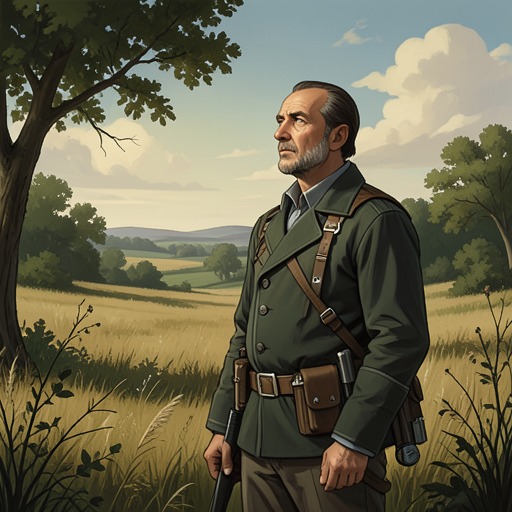
The principle takes practical form in the contrast between County Down during holidays and Surrey during term. Rather than compare the two or decide which was superior, the narrator learned to receive each place on its own terms. Surrey offered an intricacy unlike the broad horizons of the Irish landscape: narrow valleys, timber, villages concealed in hollows, field paths, sunk lanes, copses, and an unpredictable succession of cottages, farmhouses, villas, and country seats. The pleasure depended on letting the place disclose its own character, not wishing it were another landscape.
That attentiveness sharpened into a specific instruction: close the mouth, open the eyes and ears, take in what is there, and leave aside thoughts of what might have been there or what is somewhere else. Comparison, the memoir argues, can obstruct the fruition of both art and nature. The advice does not forbid comparison forever; it asks that reception come first. In Surrey, even a walk could resist possession by the mind: from Polesden Lacey the Leatherhead and Dorking valley twisted into another valley, while a train passed unseen through a wooded cutting and the opposite ridge concealed its bays and promontories. The landscape’s complexity was not a defect to overcome but the source of its particular pleasure.
The lesson is made memorable through small, concrete discoveries rather than a grand view alone. Near Friday Street, a party recognized a curiously shaped stump and realized that they had spent the last half-hour walking in a circle. Other remembered scenes include autumn afternoons in silent hollows beneath old trees and a frosty sunset over the Hog's Back at Guildford. On a winter Saturday, cold could sharpen the anticipation of tea, a fireside, and the weekend’s reading. Such details show surrender as active attention: the walker receives the weather, terrain, and limits of the walk instead of demanding a more convenient scene.
From Attention to a Way of Life
The memoir connects this receptivity to moral and religious formation. It suggests that learning to receive what is present can prepare a person for Christian life: training acquired in one domain may be useful in another, even when the first training concerned nature rather than religion. The point is not that appreciating a landscape is equivalent to religious faith, but that both can involve relinquishing the habit of insisting that reality conform to one’s preference.
A. K. Hamilton Jenkin deepens the practice by extending it beyond beauty and comfort. As the narrator’s first lifelong friend at Oxford, he continued an education in seeing, listening, and smelling. Where Arthur had fostered a preference for the Homely, Jenkin seemed able to enjoy even ugliness. His example was to seek the most dismal, dripping wood on a dismal day, the windiest ridge on a windy day, and places where a town’s squalor rose toward grimness and almost grandeur. This was not ironic amusement at unpleasantness; it was a serious, gleeful effort to encounter each thing as what it was. Total surrender thus means neither calling every condition pleasant nor pretending distinctions disappear. It means attending closely enough to receive even an unattractive reality without replacing it with an imagined alternative.
The rule also clarifies a sequence of experiences that the memoir keeps distinct. At Oldie's school, hearing Christian doctrines taught by men who evidently believed them brought previously professed beliefs to life; the narrator began praying, reading the Bible, and attempting to obey conscience. Later, however, atheistical reasoning and occult interests pulled in different moods toward the same anti-Christian result, and he became an apostate, abandoning belief with relief rather than a sense of loss. These stages are not presented as one continuous conversion. They show instead that religious commitment, imaginative experience, ethical practice, and intellectual assent can separate and change at different times.
Experiences Received Without Being Confused
Literature provides a further test of the difference between receiving an experience and forcing it into a preconceived scheme. At Campbell College, the narrator encountered Matthew Arnold’s Sohrab and Rustum in class with a master called Octie. He was moved by its cool distance, melancholy, and imagery, although he knew nothing of Homer. Years later, the Iliad became partly intelligible to him through his prior love of Arnold. The sequence reverses the expectation that a reader must first know the classical source to appreciate the later poem: remaining receptive to the encounter allowed one work to lead to another.
At Chartres, the return of Joy began not through a deliberate search but through a chance encounter with a literary periodical. The headline Siegfried and the Twilight of the Gods and an illustration by Arthur Rackham brought back a sense of Northernness and, with it, the painful recognition of an old longing that had disappeared from awareness. The image did not restore Joy as a possession; the experience vanished almost as soon as the narrator could recognize it. Its significance lay partly in showing that longing could not be summoned or controlled at will.
The encounter continued through music and books. Before hearing Wagner, the narrator had already made the printed name a kind of symbol. In a dark, crowded shop he first heard a recording of the Ride of the Valkyries, which struck him as a new kind of experience rather than simply another pleasure. Later, in Dundrum, he found the Rackham-illustrated book that had begun the chain of encounters and eventually obtained a cheaper edition with his brother’s help. These episodes are not identical to the practice of accepting an ordinary present: they concern aesthetic longing and memory. Yet their form reinforces the memoir’s distinction between receiving an experience and possessing it. The desired response arrives, alters the reader, and cannot simply be commanded to return.
Surrender and Its Religious Consequence
The rule reaches its most demanding meaning in the account of the narrator’s surrender to God. He had long wanted not to be interfered with, had sought to call his soul his own, and had tried to limit exposure to suffering. His earlier attempt to live by his philosophy remained hedged with reservations about how far reality might be allowed to make demands. Surrender therefore becomes more than openness to a landscape or an atmosphere: it means relinquishing the expectation that the most consequential reality will respect those limits.
In Trinity Term of 1929, alone in his room at Magdalen night after night, the narrator felt the approach of the God he had earnestly wished not to meet. He gave in, acknowledged that God was God, knelt, and prayed. The event was reluctant rather than emotionally consoling. In retrospect, he reads the conversion as an instance of divine humility: God accepts even a person brought unwillingly, resisting and looking for escape. What had felt like compulsion could be understood as mercy and liberation. The movement from landscape to religious surrender is not a claim that every act of attention produces faith; it is a structural development in the memoir, where repeated lessons in receiving what is present prepare the reader to understand the force of an eventual demand that cannot be bargained down.
The memoir carefully limits what this first surrender meant. It was a conversion to theism, not yet to Christianity: the narrator knew nothing of the Incarnation, and the God he acknowledged seemed nonhuman. He had no assurance that God had any connection with Joy, and he did not then believe in a future life. Only later did he reason toward Christianity through the Gospels, whose historical particularity appeared to him to unite myth and fact in the person of Christ; even then, recognizing the Incarnation required another step toward a more concrete and inescapable divine presence. Total Surrender to What Is Present therefore does not erase the distinctions among early belief, apostasy, theism, and Christian faith. It names a discipline that makes those changing encounters legible: receive what is actually given, including what resists the self’s preferred terms.